Velvet Noir & Emerald: Royalty Redefined
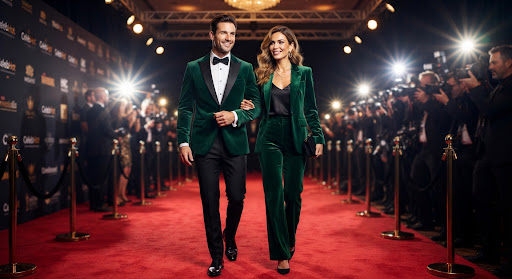
Luca Ardent and Dahlia Voss arrived in coordinating emerald and obsidian velvet tuxedos. Here is how they matched without matching, and how to pull off a coordinated entrance.
local_fire_departmentHot Points
- boltCoordinate through colour family and fabric, not identical outfits.
- boltVelvet needs sharp tailoring and plain accessories to look regal rather than costumey.
- boltJewel tones work for couples, friends and groups of any size.
Some red-carpet couples arrive in identical outfits and look like a duet. Luca Ardent and Dahlia Voss did something smarter. He wore emerald velvet; she wore obsidian velvet. Same fabric, same sharp cut, different colours that sat beautifully side by side. This story is part of CelebHot's illustrative launch edition: its people and events are fictional.
Here is what made the pairing work and how to borrow the idea.
Matching Without Matching
The trick is a shared language rather than a shared outfit. Both tuxedos used velvet with a soft sheen, both had a slim lapel and both skipped the bow tie for an open collar. Colour was the only big difference, and the two shades are close cousins in tone, both deep and slightly cool.
The effect is a visual sentence with two halves. Each person still looks like themselves, but photographed together they read as one idea.
Why Jewel Tones Photograph So Well
Deep jewel colours hold their saturation under harsh flash, where pastels wash out and black can flatten into a void. Velvet adds another layer: the pile catches light on the raised edges and absorbs it in the folds, so the fabric looks sculpted even when the cut is simple.
Emerald in particular flatters a wide range of skin tones and pairs well with warm metals such as gold or brass.
The Tailoring Is Everything
Velvet forgives nothing. A jacket that is slightly too long or a shoulder that droops will look like a costume. Stylist Camille Ferro has often argued that velvet should be fitted twice, once standing and once seated, because the fabric creases differently.
- Shoulders: the seam should sit at the end of the bone, not past it.
- Sleeve length: show a thin edge of shirt cuff.
- Trouser break: clean and short, so the velvet is not bunching over the shoe.
- Lining: a smooth lining helps the jacket slide on and hang cleanly.
"Couples think matching means identical. It really means agreeing on the rules, then letting each person break one." - Isolde Marchetti, image consultant (fictional)
How to Coordinate Your Own Entrance
You do not need a gala to try this. For a wedding, a birthday dinner or a night out, agree on a few simple rules with your partner or friends before you get dressed.
- Pick one shared fabric or texture, such as velvet, satin or wool.
- Choose two or three colours from the same mood, such as deep greens, burgundies or navy.
- Agree on a formality level so nobody ends up in sneakers beside a tuxedo.
- Let accessories differ: one gold watch, one silver ring, whatever feels personal.
If velvet is out of budget, borrow, rent or search second-hand racks. A vintage velvet jacket can be taken in by a local tailor for far less than a new suit costs, and it often has better fabric.
A coordinated look is only successful if both people can move, sit, eat and dance in it. Velvet is warm, so choose a lighter weight for summer events, and keep a lint roller in your bag, because pile attracts dust. Hang the garment rather than folding it, and let it air out after wearing. Steam it from a distance instead of pressing it, since an iron can crush the pile flat and leave a permanent shine.
It also helps to rehearse. Wear the outfits at home for an hour, sit on a hard chair, raise your arms, and walk up and down a staircase. Anything that pinches, rides up or itches will only get worse after three hours at an event, and a quick alteration beforehand is far easier than a panicked fix in a cloakroom.
Finally, think about the photographs. Stand slightly angled, with a little space between you, so the two colours can be seen as separate shapes rather than one dark blur. Couples who lean into each other too tightly can lose the contrast that made the pairing interesting in the first place. A small step apart, and a shared smile, will do more than any pose.
The Takeaway
Great couple style is agreement, not duplication. Share a fabric, share a colour mood and invest in the tailoring, then let each person wear it in their own way.
Style Editor at CelebHot. A fictional byline for the illustrative launch edition. Meet the masthead.